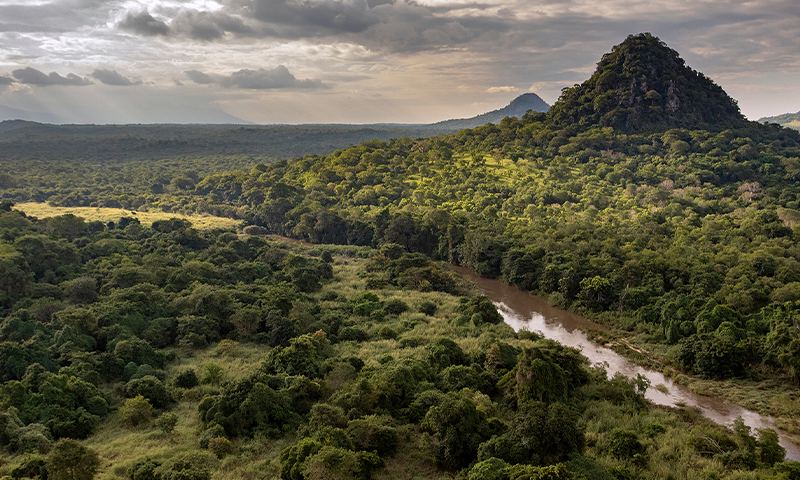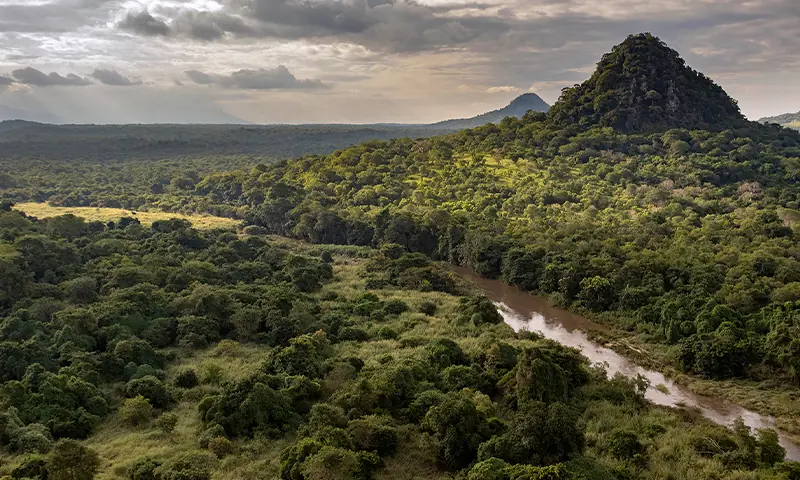
Gorongosa is famous for what has come back: the lions, the elephants, the floodplain at dawn. Beneath that famous surface sits a far older story, and a team of scientists is only now beginning to read it. According to the park's own Paleo-Primate Project page, Gorongosa lies at the last unstudied link in the East African Rift, the great fracture in the earth where much of what we know about human origins has been found.
The short answer
- Who leads it: Dr Susana Carvalho, Director for Paleoanthropology and Primatology at Gorongosa National Park, with an interdisciplinary team of more than 30 scholars from institutions in 14 countries across five continents.
- What it found: the first Miocene fossils from coastal woodlands in the southern East African Rift. The Miocene spans roughly 23 to 5.3 million years ago.
- Why it stands out: the fossil assemblage mixes marine and terrestrial species, a combination the project says is not known at any other East African Rift site.
- Why it matters: the aim is to understand when and how early human ancestors evolved, the environments they lived in, and the plants and animals around them.
Why a fossil hunt belongs in a wildlife park
Most rift sites that have given us fossils lie inland, in dry country. Gorongosa sits closer to the Indian Ocean, and the fossils found here come from coastal woodlands. That is a different kind of landscape, and different landscapes ask different questions: which habitats did early primates use, and how did they move through them as climates shifted?
The project describes the work as potentially a multi-decade effort. The team has surveyed for fossil sites, found new ones and identified several promising places to dig. This is patient science, and the park is the setting for it.
Five primates, and a lot of baboons
The project is not only about the deep past. Gorongosa has five species of non-human primate today, including an unusually high density of baboons. Earlier Oxford-led primatology projects here, carried out by students and a postdoctoral researcher, looked at culture, predation pressure, communication and leave-taking behaviour. Watching living primates in a complex habitat is one way to model how our ancestors may have coped in similar ones.
Study today's primates in a living landscape, and you get a window onto how ancestors might have adapted to theirs.
A school that fills with Mozambicans
The part we admire most is the teaching. The Oxford-Gorongosa Paleo-Primate Field School launched in 2018 and is now run with ICArEHB as the Gorongosa Interdisciplinary Field School in Human Evolution. It runs every year, and at least half of its participants come from Mozambican universities, including Universidade Eduardo Mondlane. One alumna, Rassina Farassi, studied object manipulation and play in Gorongosa's baboons and went on to a Master's in primatology.
Gorongosa's story is not only about animals returning. It is about who gets to study them, and whose science it becomes.
What this means for a visit
You do not need to be a scientist to feel this. On our Fire leg, you travel through the same landscape the researchers work in, guided by people who know it well. Ask your guide what lived here before the lions, and what the ground is still holding. We cannot promise a visit to a dig site, because research access is the project's decision, but we can ask on your behalf. We have written separately about what the restoration delivers for local people and how the park was funded.
What this article cannot tell you
The page we drew on does not give species names, fossil counts or a start date for the project, and we have not added any. It is the project's own description, so please treat the findings as reported by the team and read the project page for updates.
Source: Gorongosa National Park, Paleo-Primate Project. Details are as described there at the time of writing and may have changed.
Frequently Asked Questions
What is the Gorongosa Paleo-Primate Project? A research programme led by Dr Susana Carvalho that studies fossils and living primates in Gorongosa National Park to understand early human ancestors and the environments they lived in.
What has been found at Gorongosa? According to the park, the team unearthed the first Miocene fossils from coastal woodlands in the southern East African Rift, in an assemblage that mixes marine and terrestrial species.
How many primates live in Gorongosa today? The project reports five non-human primate species, including an exceptionally high density of baboons.
Can I visit a fossil site with Elementa Africa? Research access is decided by the project, so we cannot promise it, but we can ask on your behalf. Our Fire leg stays in Gorongosa National Park.